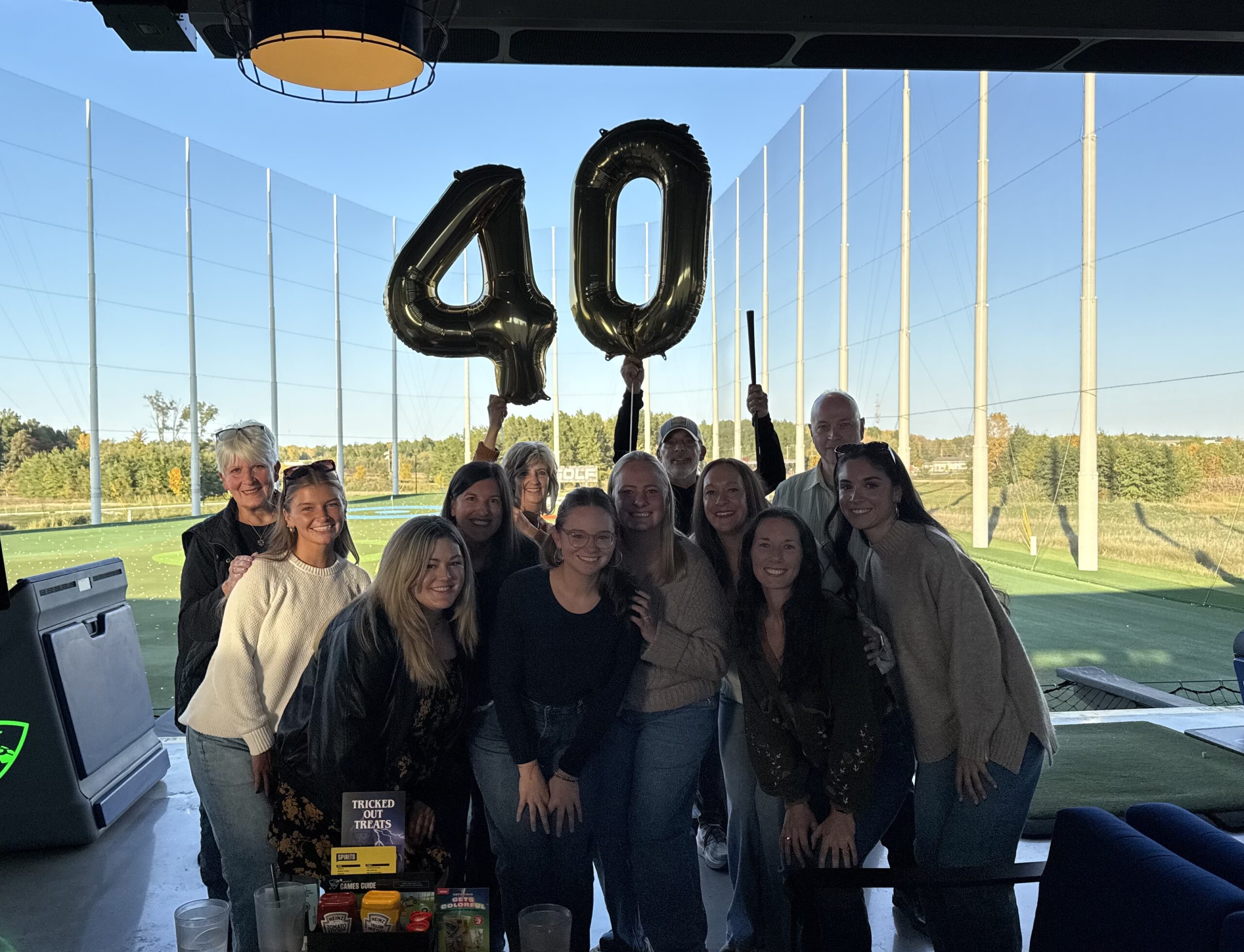
Be Great and Do Good: A Conversation with Jim Sweeney Celebrating 40 Years
Jim Sweeney didn’t set out to build a marketing agency. Rather, its history is a story of an unexpected start, a deliberate commitment to treating people well and a willingness to adapt as marketing and technology changed over time.
As Sweeney celebrated its 40th anniversary this past month, we sat down with Jim to reflect on the agency’s early days, the decisions that shaped its growth and the values he hopes will carry forward for years to come.
Q: What circumstances were going on at the time that made you decide to start Sweeney?
A: I always thought there should be this really cool story about how I had this great plan to start an agency, but the truth is I did not.
It was 1986, the company that I worked for and loved – Burson-Marsteller – was closing its operation in Cleveland, and they wanted me to return to Chicago. Unfortunately, leaving Cleveland was not a viable option at the time. So, I started looking for work, but after weeks of searching and interviewing, I realized there wasn’t another agency or corporate opportunity that I was drawn to. So, what was I supposed to do?
I never had the dream or ambition to start an agency, but I did have clients who were asking me to manage their marketing projects. Eventually I formulated a plan and got started.
Q: What were you seeing in the marketing world that you knew you wanted to deviate from?
A: When I decided I was going to start an agency, I carefully considered my agency experience over the previous six years. What was it that I really liked about the business, and equally important, what did I not like? If I am truly going to start a new agency, how can I do things better?
One thing that troubled me in our industry back in the early ‘80s was how agencies treated their employees. For the most part, we were all overworked and underpaid. In particular, women were generally paid less and disrespected more; it was just a bad situation.
Likewise, vendor partners – media, printers, art studios, photographers and videographers – were treated like second-class citizens, despite the fact that we relied on them to get our work done.
I wanted to create an agency that was truly flat, fair and equitable. I believed that if we leveled the playing field and didn’t have to worry about how we were treating employees, vendors and clients, we could focus 100% of our attention on being really good at what we do.
If I was going to do this, I wanted to have a different kind of agency that looked at the industry differently.
Q: What did the agency’s early days look like?
A: In the beginning it was just me. I found an office building in Lakewood, Ohio that was being renovated, and I was one of its first two tenants. I had a desk, an electric typewriter and a telephone. That was the whole operation.
Out client roster was equally simple. We had project work with Blue Cross and Blue Shield of Ohio, grand openings with the Wholesale Club and a couple of prospects. But by the end of 1986, which grossed a whopping $8,000 in billings, we had found our footing. And in 1987, we made our first and second hires, Jennifer Armstrong and Kelly Erickson, who is still with the agency 39 years later and serves as the agency’s Chief Financial Officer.
By 1988 we had a dozen clients, 4 or 5 employees, new offices and the latest technologies, including a network of Apple computers. The business was growing, and we were starting to find our true identity and strength.
Q: How did strategy become central to the way Sweeney serves clients?
A: In the mid-1980s, most agencies were either focused on advertising or PR; some agencies pretended to be integrated, but in truth, they were separate disciplines in every respect. So, we entered the industry selling PR services, because that was what I knew best.
But we quickly realized that observing client needs and solving problems was a far more productive way to operate than selling a service. As a result, we ended up evolving quickly beyond basic publicity services and ended up planning and directing events, writing and designing brochures, developing educational materials, directing ad campaigns and more. Instead of selling specific services, we provided whatever solutions were needed.
And we realized that the future of our industry – at least for us – was in strategic marketing – conducting research, planning strategies and executing targeted campaigns to achieve specific business goals.
We helped clients understand their business problems, opportunities and challenges, and we showed them how marketing could help solve those problems.
Q: What technological shifts most changed the way the agency worked?
A: The state of technology in the mid-1980s was still evolving and the marketplace was slow to adapt. As for our new agency, we decided that working with electric typewriters was not a very efficient way to use our time. And while “personal” computers were not yet a thing, we bought Apple computers with the hope that we could improve our productivity and maybe even our performance. We were pretty proud of our decision to embrace technology early on, and it paid off.
By the early 1990s technology was all the rage. Everyone had computers and the Internet allowed them to communicate with each other. Then came email and cell phones and social media, and now here we are adapting to AI. It’s been a crazy evolution.
Almost everything we use to run the business today didn’t exist when we first started, yet it hasn’t completely changed the business. In the end, we’re still marketers. We’re still doing the same work in terms of quality and performance, and we’re still building meaningful relationships.
Q: Which parts of the agency’s philosophy do you most want to see carried forward?
A: Treat our clients well, treat our employees well, treat our vendor partners well. For the past 40 years, we have focused on building professional-personal relationships that involve being exceptionally good at what we do while also being exceptionally good to the people we work with.
So, creating and executing campaigns that deliver great results is just part of the equation. Being a friend and a resource to our employees, clients and partners is equally important. I have believed for a very long time that we have a responsibility to be great and do good. Those two things together have created a different kind of agency that has thrived for four decades now and, I believe, can take us boldly into the future.
Share this article

Written by : Gabriella Billotti
Gabriella Billotti is an Assistant Account Executive at Sweeney with a passion for combining creative storytelling and strategic thinking to help brands connect with their audiences. She graduated from the University of North Carolina Wilmington with a bachelor's degree in Business Administration and a concentration in Marketing Strategy. Her background includes experience in social media strategy, content creation, marketing analytics and consumer research. Gabriella brings a creative, detail-oriented and collaborative approach to her work, always looking for new ways to bring ideas to life and drive meaningful results.